February 23, 2026
After halfway point, a continued focus on business-friendly laws and balanced policy decisions
Week six of Virginia’s 2026 General Assembly marked one of the most significant turning points of session: the halfway mark of Crossover has passed, and the House of Delegates and Senate budget proposals were unveiled on "Budget Sunday," February 22. The landscape has shifted accordingly.
With Crossover behind us, the universe of active bills is much smaller, amendments get made and budget cuts will force bills aside. Our priorities remain focused on business-friendly legislation that promotes fair and balanced policy decisions for Virginia’s dealer industry.
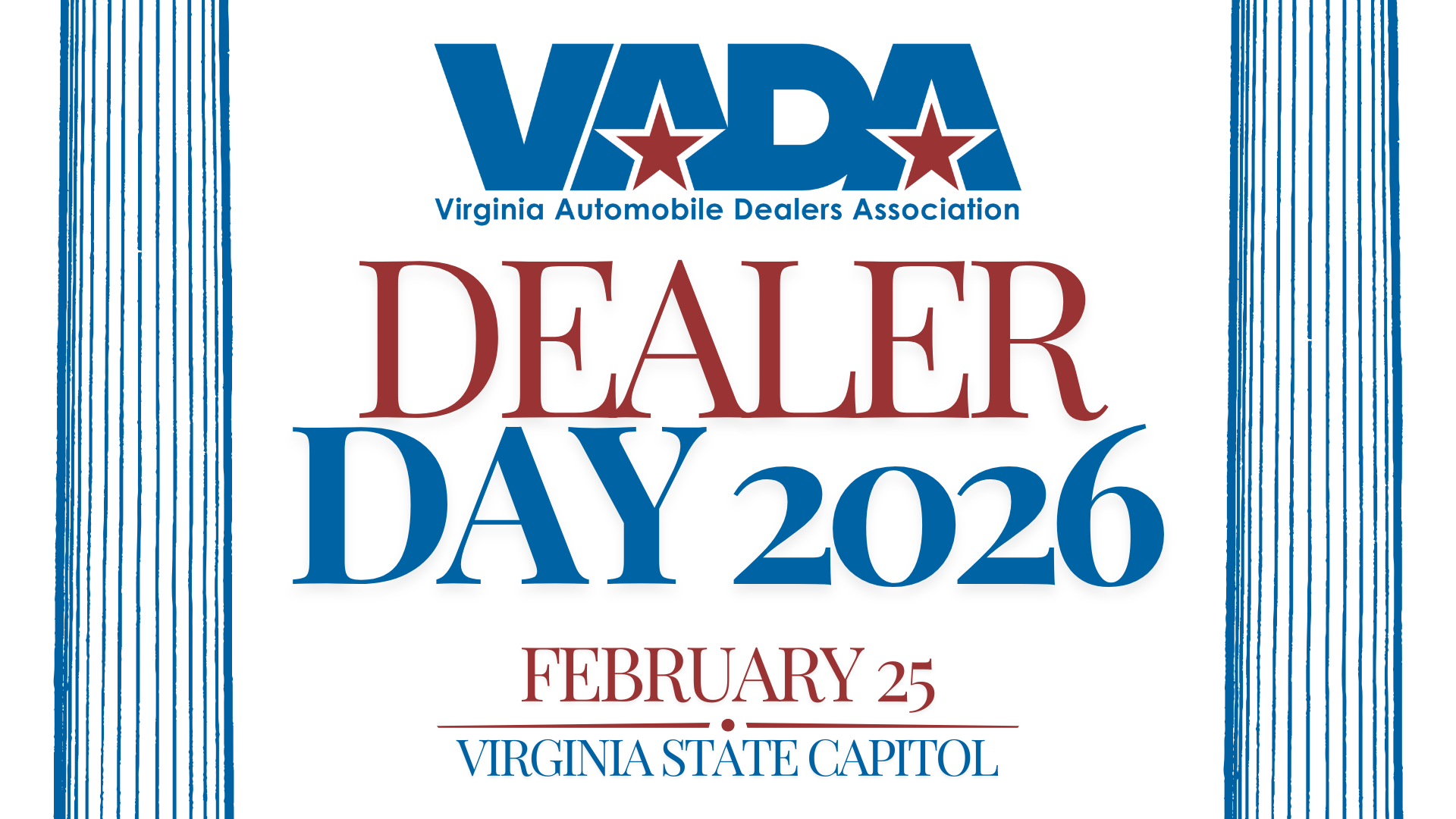
The pace will remain brisk, but the focus sharpens from here for these final weeks of Virginia’s 2026 legislative session. This week is also Dealer Day at the Capitol and will bring dozens of dealers to Richmond to meet with lawmakers. Be sure to register below if you have not already.
Crossover has passed. Here's what that means.
 Crossover is the deadline by which each of Virginia’s legislative chambers must complete work on its own legislation (with limited exceptions, primarily budget-related).
In practical terms:
- If a House bill did not pass in the House by Crossover, it is effectively dead for the year.
- If a Senate bill did not pass the Senate, the same applies.
- Bills that passed out of their originating chamber now “crossover” to the other chamber for consideration.
After Crossover, the landscape of bills which are still in play for the year is dramatically narrowed. As discussed in last week’s Capitol Briefs and our recent Crossover episode of VADA Live, many problematic bill proposals are now off the table, and our focus shifts to:
- Catching any remaining harmful bills in the second chamber
- Watching tracked bills for amended language, and protecting favorable language
- Navigating bill versions and preparing for conference committees
Crossover always brings clarity as to the intent of the legislature’s leadership – and this year is no exception.
Why Budget Sunday matters
On Sunday, the House and Senate Finance Committees each released their proposed budget amendments to former Gov. Glenn Youngkin’s proposed 2026-2028 budget.
This is the starting point for budget negotiations between the chambers. From here, funding decisions affecting all aspects of Virginia policy begin to take shape. Of course, the budget won’t be final until new Gov. Abigail Spanberger has a chance to insert her own budget priorities.
Tax and transportation funding bills fail
Several pieces of legislation aimed at funding transportation through tax changes have failed in the session. This is an advocacy win for VADA, as many of these proposed tax increases would have impacted Virginia consumers and your operations.
- HB900 (Del. Richard "Rip" Sullivan) & SB730 (Sen. Scott Surovell) would have decreased the sales and use tax rate while increasing the base of taxable sales, to include a tax on motor vehicle repair services.
- HB1179 (Del. Kathy Tran) & SB638 (Sen. Adam Ebbin) would have increased the highway use fee, taxed deliveries, taxed rideshare rides, and imposed several regional tax increases to fund transportation.
- HB978 (Del. Vivian Watts) would have expanded the sales and use tax base to include taxes on digital personal properties and services, including a tax on motor vehicle repair services.
Reminder: Dealer Day is Wednesday. Get details below.
Several bills impacting vehicles are done for the year
A handful of bills that VADA has been monitoring, as they touch on automobiles or dealer operations, failed to pass out of the House of Delegates.
- HB1125 (Del. David Reid) – Autonomous Vehicle Framework: Would have established a framework for the operation of fully autonomous commercial vehicles in Virginia.
- HB890 (Del. Richard "Rip" Sullivan) – Fleet Electrification: Would have set goals for the electrification of Virginia’s fleet vehicles.
- HB179 (Del. Bonita Anthony) – Fleet Modernization Advisory Council: Would have created a Fleet Modernization Advisory Council to study efficient means to modernize the state’s vehicle fleet.
- HB1143 (Del. Terry Austin) – Discontinue Registration Decals: Would have eliminated the requirement to display license plate registration decal stickers.
- HB1251 (Del. Jackie Glass) – Digital Right to Repair: Would have required vehicle manufacturers to provide vehicle diagnostic repair software broadly.
Meanwhile, other motor vehicle and dealer bills continue moving forward
Several bills impacting dealer operations continue to have support in both chambers.
HB570 (Del. Michael Feggans) – Dealer Records
- Status: Passed Senate Transportation (15-0), now on the Senate floor calendar
- The bill modernizes dealer record-keeping by allowing electronic preservation without prior DMV approval, cleaning up obsolete requirements
HB586 (Del. Scott Wyatt) – Dealer Business-Hours Filing
- Status: Passed Senate Transportation (15-0), now on the Senate floor calendar
- This bill shifts filing of dealer business-hour changes from the DMV to the Motor Vehicle Dealer Board – a logical regulatory adjustment reflecting modern practices.
HB608 (Del. Scott Wyatt) – Dealer Plate Use Expansion
- Status: Passed Senate Transportation (15-0), now on the Senate floor calendar
- This bill authorizes the limited use of dealer plates for parts/fuel delivery and vehicle transport to retail supply facilities. Strong bipartisan support signals the legislator’s comfort with the bill’s narrow scope and practical utility.
HB1389 (Del. Scott Wyatt) – Motor Vehicle Transaction Recovery Fund
- Status: Passed House (97-0), referred to Senate Transportation
- This bill would allow recovery from the Fund for losses or damages to a consumer resulting from the breach of an extended service contract by a licensed dealer participating in the Fund. This bill received an unfavorable fiscal impact statement, which said that the bill could increase the claims filed against the Fund and ultimately cause it to become insolvent. VADA suggested an amendment which tightened the language to protect against broad and attenuated claims against the Fund, which helped assuage the concerns of legislators. As it stands, it is too soon to know how this bill could impact the Fund, but we will continue to watch this situation should it pass.
SB440 & SB441 (Sen. Lamont Bagby) – License Plate Use Extensions
- Status: Passed Senate (40-0), referred to House Transportation's Department of Motor Vehicles subcommittee
- Both bills are aimed at increasing the flexibility of dealers when a customer has a vehicle in their shop for a lengthy repair. Should these bills pass, customers would be able to use their own license plate on a loaner vehicle for 30 days, instead of 5 days - which is the rule under current law - with a permit that would also be valid for 30 days.
HB1145 (Del. Terry Austin) – Safety Inspections
- Status: Passed Senate Transportation (13-0), now on the Senate floor calendar
- While this bill initially sought to increase the period between motor vehicle safety inspections from 12 months to 24 months, the amended version removes regulatory barriers in hopes of increasing the amount of certified inspection stations in Virginia.
HB312 (Del. Kacey Carnegie) & SB767 (Sen. Luther Cifers) – Glass Repair & Replacement
- Status: HB312 passed the House (96-3) and was referred to Senate Commerce & Labor; SB767 passed the Senate (39-0)
- These bills make it a violation of the Virginia Consumer Protection Act for a motor vehicle glass repair facility to fail to notify customers about advanced driver assistance systems in their vehicle, and of the repair shop’s ability to recalibrate such systems following a repair. The Senate version of the bill received an amendment in Senate Finance and Appropriations. It allows for emissions inspection waivers in the event that a vehicle failed an initial inspection and its onboard diagnostic system is in a not-ready condition to be tested when presented for re-inspection when the owner has written proof of emissions maintenance on the vehicle since the initial inspection.
HB55 (Del. Rip Sullivan) – Noise Abatement Monitoring Systems
- Status: Passed House (64-34), referred to Senate Transportation
- This bill will allow certain Virginia localities to pilot automated noise monitoring systems to enforce vehicle exhaust violations, focusing on vehicle decibel levels greater than 96.
HB1008 (Del. Kathy Tran) – EV Tax Credit Reciprocity
- Status: Passed House (97-0), referred to Senate Finance and Appropriations
- This bill will allow a tax credit for EV purchasers who move to Virginia within 12 months of purchasing an EV in the state they previously resided.
HJ34 (Del. Lily Franklin) – A Study abolishing Virginia's personal property tax on vehicles
- Status: Passed House (68-25), and in Senate Finance & Appropriations
- This bill directs the tax department to study options to eliminate the personal property tax on vehicles in Virginia and to determine alternative sources of local revenue – a measure supported by Virginia’s localities.
HB1309 (Del. Jason Ballard) – GAP Insurance & Waivers
- Status: Passed House (97-0), referred to Senate Commerce and Labor
- While guaranteed asset protection (GAP) insurance has been allowed by Virginia’s State Corporation Commission, this bill will make it clear that Virginia law allows for GAP insurance products and GAP waivers to be sold.
HB808 (Del. Dan Helmer) – Modification of Loss Estimates
- Status: Passed House (97-0), referred to Senate Commerce and Labor
- This bill prohibits public insurance adjusters from modifying estimates of loss unless the revised estimate includes detailed explanations as to why any modification occurred. This will impact dealings between auto body shops, their customers, and insurance providers.
HB1124 (Del. Nadarius Clark) – Autonomous Vehicle Work Group, Workforce
- Status: Passed House (97-0), referred to Senate Transportation
- This bill directs an existing autonomous vehicle work group to conduct an assessment on the workforce impacts created by autonomous vehicles.
SB135 (Sen. Bill DeSteph) – DMV Title Database
- Status: Passed Senate (32-8), referred to House Transportation, Department of Motor Vehicles subcommittee
- This bill would allow the DMV to join a national vehicle title database to share motor vehicle owner and lienholder information as an effort to crack down on title washing and title fraud.
SB595 (Sen. Bill DeSteph) – DMV Mechanics & Storage Lien Data
- Status: Passed Senate (29-11), referred to House Transportation, Department of Motor Vehicles subcommittee
- This bill would allow the DMV to share mechanics or storage lien information against vehicles titled in other jurisdictions with holders of the vehicle.
Transportation committee changes
With the new Spanberger administration tapping several sitting legislators for positions in her administration, there have been numerous special elections to fill House and Senate seats since late last year. Committee assignments have been reshuffled based on the arrival of these new members in each body. The Transportation Committees have seen the following changes.
House Transportation Committee (as of week 6)
Delaney (Chair), Reid (Vice Chair), Ward, McQuinn, Carr, Watts, Sewell, Glass, McClure, Anthony, Feggans, Guzman, Mehta, Thomas, Austin, Wyatt, Wiley, O'Quinn, Ballard, Phillips, Pope Adams
Senate Transportation (as of week 6)
Bagby (Chair), Marsden, DeSteph, Suetterlein, Boysko, Hackworth, Sturtevant, Aird, Roem, Diggs, Pekarsky, Mulchi, Srinivasan, Cifers, Jones, M., Bennett-Parker
Newsworthy: IEEPA tariffs struck down by SCOTUS: What auto dealers need to know
On February 20, 2026 the Supreme Court ruled 6-3 that the International Emergency Economic Powers Act (IEEPA) does not authorize the President to impose tariffs. The effect of this decision is broad, however, the practical impact on your dealership is limited. The 25% tariffs on imported vehicles and auto parts as well as the 50% tariffs on raw materials including steel and aluminum — the ones driving your and consumer cost increases — were imposed under Section 232, not the IEEPA, and remain fully in effect.
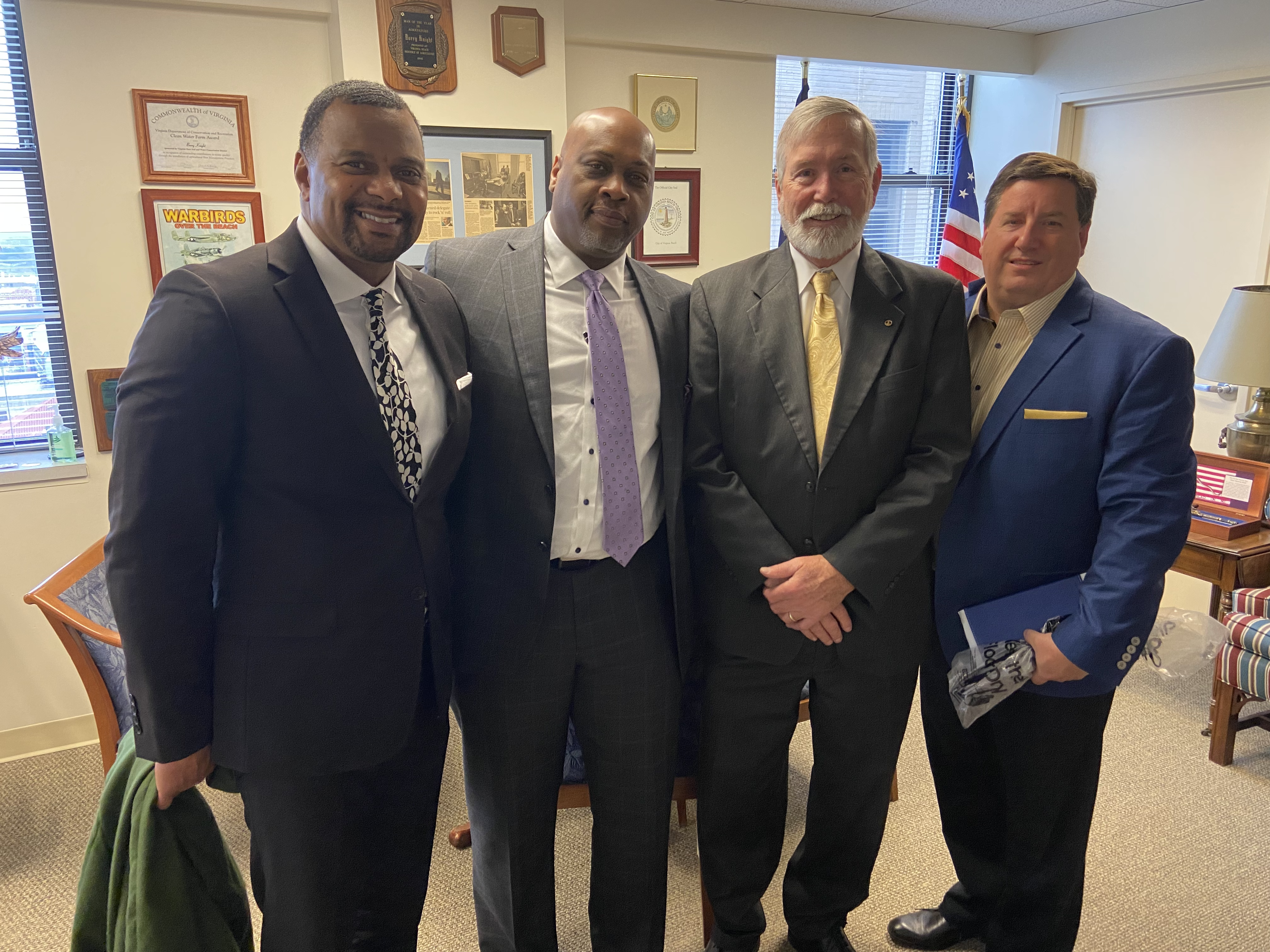
Remembering Virginia Beach lawmaker and VADA friend Del. Barry Knight
The VADA team and our dealers send our condolences to family and fellow friends of Del. Barry Knight, who passed away on Thurday. The farmer, husband to Paula, father of three, and grandfather to four was a 17-year member of the House of Delegates and close with the VADA team due to his role on the Transportation Committee. As Gov. Abigail Spanberger said, he “personified what it means to be a citizen legislator.” Del. Knight is pictured here on Dealer Day 2023 with Priority Automotive's James Church, Parks Chevrolet's RJ Robinson, and Tim Pohanka of Pohanka Nissan/Hyundai of Fredericksburg.
A key focus of the 2026 session: Employment & Business bills
HB1 (Del. Jeion Ward, D-Hampton) & SB1 (Sen. Louise Lucas, D-Portsmouth) — Increasing the Minimum Wage
- Status: HB1 passed House (64-34), referred to Senate Commerce & Labor; SB1 passed Senate (20-19), referred to House Labor & Commerce.
- These identical companion bills incrementally increase Virginia’s minimum wage to $15 per hour by January 1, 2028 and require an annual adjustment to reflect the consumer price index after that.
The goal behind the legislation is to provide predictability and long-term stability for both employees and employers. However, it represents a significant long-term shift in employer wage obligations and it will remain a closely watched issue for Virginia employers.
HB18 (Del. Adele McClure) & SB3 (Sen. Lashrecse Aird) — Employee Child Care Program
- Status: HB18 passed the House (91-7) and was referred to Senate Finance & Appropriations; SB3 passed the Senate (39-0) and was referred to the Senate Appropriations Elementary & Secondary Education Subcommittee.
- These bills establish a new state-supported program to incentivize employees to contribute to childcare costs. Thus far, this initiative has received strong bipartisan support and will hopefully support workforce retention and Virginians' access to childcare, if enacted.
HB238 (Del. Alfonso Lopez) – Wage & Overtime Liability Expansion
- Status: Passed House (64-35), referred to Senate Commerce & Labor
- This bill expands employer liability for minimum wage, overtime, and worker misclassification violations while tying remedies to the wage payment statute (including liquidated damages and attorney’s fees). This remains a significant expansion of exposure for employers and continues to warrant close engagement as it moves in the Senate.
HB930 (Del. Marcus Simon) – Whistleblower Expansion
- Status: Passed House (63-35), referred to Senate Commerce & Labor
- This bill contemplates a major expansion of Virginia’s whistleblower protections. While punitive damages were removed from the bill in a committee substitute, the bill still:
- Broadens protected activity significantly
- Creates additional rights of action
- Limits employer handbook restrictions
- Sets a high burden of proof for employers
The business community has been actively engaged in this legislation. It continues to present meaningful compliance and litigation considerations for employers. VADA continues to monitor this closely as it moves along in the legislative process.
SB644 (Sen. Scott Surovell) – Wage Liability & Whistleblower Protections
- Status: Passed Senate (20-19)
- This bill combines the policies in HB238 and HB930 for an omnibus approach to civil actions brought by employees and expands employee protections in court. A deep dive on this bill can be found in the week 4 Capitol Briefs.
SB199 (Sen. Barbara Favola) & HB5 (Del. Kelly Convirs-Fowler) – Paid Sick Leave
- Status: SB199 passed the Senate (21-19); HB5 passed the House (63-35) and was referred to Senate Commerce & Labor
- These bills will require employers to provide one hour of paid sick leave to each employee for every 30 hours worked.
VADA is continuing to work alongside the business community to ensure that these proposals are implemented in ways that are workable and balanced for employers.
HB449 (Del. Marcus Simon) & SB229 (Sen. Scott Surovell) – Class Actions
- Status: HB449 reported favorably from Senate Courts of Justice (10-4) and was referred to Senate Finance & Appropriations; SB229 reported favorably from House Courts of Justice (15-7) and is now on the House floor calendar.
- These bills establish procedures for class action claims in Virginia courts. Currently, Virginia and Mississippi are the only two states without state-level class actions. Virginia’s business community remains focused on conforming the procedures set forth to match federal class action procedures – which would include an amendment for meaningful summary judgment in Virginia. This item will likely be a work in progress until the bill’s delayed enactment in 2027. However, the business community faces strong pushback from trial lawyers on the inclusion of more business-friendly amendments.
HB1207 (Del. Briana Sewell) & SB2 (Sen. Jennifer Boysko) – Paid Family Medical Leave Program
- Status: HB1207 passed House (62-34), referred to Senate Commerce & Labor; SB2 passed Senate (21-19)
- These bills establish a statewide paid family medical leave insurance program, allowing eligible employees to receive partial wage replacement for certain family and medical leave events. This program would be funded by premiums assessed to employers and employees beginning April 1, 2028, with benefits beginning January 1, 2029.
As this could have long term cost implications on Virginia’s businesses, we are continuing to coordinate with the broader business community to ensure employer impacts are fully considered as these bills move forward.
As always, please reach out if you have questions about how any of these measures could affect your operations. We are actively engaged in both chambers and continuing daily conversations with legislators, staff, and regulatory partners.
More to come as bills cross chambers, hearings ramp up, and the budget continues in negotiation this week.
Wednesday is Dealer Day at the Capitol. Be there.
Dealer Day gives Virginia's franchised auto dealers and their teams the opportunity to make a year-long impact. Show up along with other dealers, employees, and industry partners and lets show lawmakers the importance of the franchise system.
VADA Dealer Day at the Capitol 2026
Wednesday, February 25, 2026
(Then walking to meetings at the Virginia State Capitol)
Start: 501 E. Broad Street
Richmond, VA 23219
11:30 a.m. - 4 p.m.