March 9, 2026
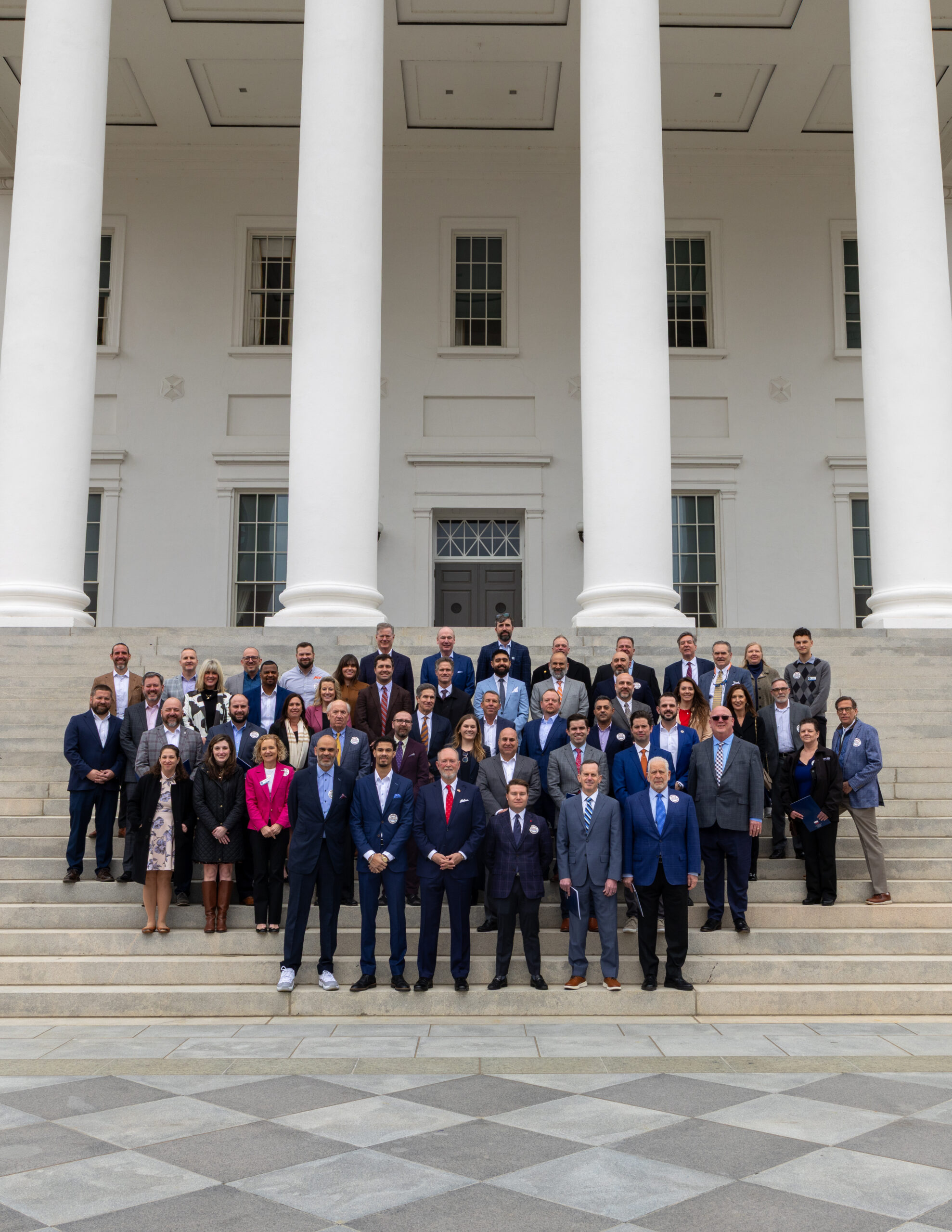
Virginia's dealership leaders and employees at VADA's 2026 Dealer Day at the Capitol on Feb. 25.
Autonomous vehicles spark debate as General Assembly enters final week
The Virginia General Assembly has entered the final stretch of the 2026 legislative session, and the pace of activity in Richmond reflects that reality. With only days remaining before adjournment, legislators spent the past week moving large volumes of legislation across the floor while negotiations continued behind the scenes on several major policy issues.
At this stage, much of the General Assembly’s attention remains focused on the state budget and reconciling differences between House and Senate versions of legislation.
Discussions pick up on autonomous vehicles
One of the most notable moments of the week occurred during the House Transportation Innovation subcommittee, where there was heated debate over autonomous vehicle policy.
Fairfax Sen. Saddam Azlan Salim’s SB670, meant to create a framework for commercial autonomous vehicle operations in Virginia, unexpectedly became the center of a contentious dispute when it reached House members. As the bill was presented to the House committee, lawmakers debated the broader policy implications of expanding autonomous vehicle operations.
Stakeholders and delegates expressed differing opinions about liability, and the pace at which this emerging technology can be safely integrated into Virginia’s cities.
Ultimately, House members signaled that Virginia is not yet ready for autonomous vehicles. It is a debate that reflects a growing reality in policymaking: as new technologies emerge faster than ever, lawmakers are grappling with how to balance innovation with consumer protection and public safety. The issue is unlikely to disappear and will likely return next year.
Additionally, Suffolk Del. Nadarius Clark’s HB1124 — a bill directing an existing autonomous vehicle workgroup to assess the workforce impacts of autonomous vehicles — advanced this week.
Procedural drama on the Senate floor
Virginia’s legislature is typically known for orderly and predictable floor proceedings. But one of the bills VADA is tracking saw a bit of drama.
During debate over HB55 — legislation to allow certain Virginia localities to pilot automated noise-abatement monitoring systems to enforce excessive vehicle exhaust noise violations — the bill experienced a rare procedural reversal.
The measure, patroned by Fairfax Del. Richard "Rip" Sullivan, was initially defeated on the Senate floor (18–22) before a motion to reconsider the vote was immediately adopted unanimously. The bill was then held for further consideration.
Procedural episodes like this highlight the unpredictable dynamics that can emerge as controversial policy issues come to the floor during the final days of session.
Here's what’s headed to the governor’s desk so far
HB1 (Del. Jeion Ward, D‑Hampton) & SB1 (Sen. Louise Lucas, D‑Portsmouth) — Increasing the minimum wage
These identical companion bills incrementally increase Virginia’s minimum wage to $15 per hour by Jan. 1, 2028, with annual adjustments tied to the Consumer Price Index thereafter. Supporters argue the policy provides predictability and long‑term stability for both employees and employers. However, it represents a significant long‑term shift in employer wage obligations and will remain a closely watched issue for Virginia employers.
HB18 (Del. Adele McClure) & SB3 (Sen. Lashrecse Aird) — Employee child care program
These bills establish a new state-supported program to incentivize employers to contribute to child care costs. The initiative has received strong bipartisan support and is intended to improve workforce retention and access to child care for Virginia families.
HB449 (Del. Marcus Simon) & SB229 (Sen. Scott Surovell) — Class actions
These bills establish procedures for class action claims in Virginia courts. Currently, Virginia and Mississippi are the only two states without state-level class action procedures. Virginia’s business community remains focused on aligning the procedures with federal class action standards, including amendments that would allow meaningful summary judgment in Virginia courts. This issue will likely remain a work in progress until the bill’s delayed enactment in 2027. The business community continues to face strong pushback from trial lawyers regarding business-friendly amendments.
HB570 (Del. Michael Feggans) — Dealer records
The bill modernizes dealer record-keeping by allowing electronic preservation without prior DMV approval and removing obsolete requirements.
HB586 (Del. Scott Wyatt) — Dealer business-hours filing
This bill shifts the filing of dealer business-hour changes from the DMV to the Motor Vehicle Dealer Board, reflecting modern administrative practices.
HB608 (Del. Scott Wyatt) — Dealer plate use expansion
The bill authorizes limited use of dealer license plates for transporting vehicle parts, accessories and small quantities of fuel, as well as trips to automotive supply retailers.
HB1145 (Del. Terry Austin) — Safety inspections
Earlier versions of the bill proposed extending inspection intervals from 12 months to 24 months. The final version instead removes regulatory barriers to increase the number of certified safety inspection stations in Virginia.
HB312 / SB767 — Glass repair and replacement / ADAS disclosure
These bills require glass repair facilities to notify customers when their vehicle includes advanced driver assistance systems and whether the shop can recalibrate those systems following repair.
HB1309 (Del. Jason Ballard) — GAP insurance and waivers
While guaranteed asset protection (GAP) insurance has been allowed by the State Corporation Commission, this bill clarifies that Virginia law allows GAP insurance products and GAP waivers to be sold.
SB595 (Sen. Bill DeSteph) — DMV mechanics and storage lien data
This bill allows the DMV to share mechanics or storage lien information against vehicles titled in other jurisdictions with holders of the vehicle.
Major employment legislation still advancing
Employment law remains one of the most active and consequential areas of policy this session. Several bills that could significantly affect employer compliance obligations and litigation exposure continue to advance.
HB238 (Del. Alfonso Lopez) — Wage and overtime liability expansion
Status: Reported favorably from Senate Finance and Appropriations (10–4)
This legislation expands employer liability for violations of minimum wage, overtime, worker misclassification and prevailing wage laws by tying remedies to Virginia’s wage payment statute.
Under the proposal, employers found in violation could face expanded damages and attorney’s fees in civil actions brought by employees. The bill cleared another hurdle this week when it was reported from Senate Finance and Appropriations and now heads toward further floor consideration.
HB930 (Del. Marcus Simon) — Whistleblower expansion
Status: Reported favorably from Senate Finance and Appropriations (10–5)
This bill expands Virginia’s whistleblower protections and creates additional potential causes of action against employers. While earlier amendments removed punitive damages provisions, the bill still broadens protected activity and raises the evidentiary burden employers must meet in certain cases.
Like HB238, the bill advanced this week and remains a closely watched issue for Virginia’s business community.
SB644 (Sen. Scott Surovell) — Wage liability and whistleblower protections
Status: Headed to a conference committee
This bill combines the policies in HB238 and HB930 into an omnibus approach to civil actions brought by employees and expands employee protections in court. A deeper dive on this bill can be found in the Week 4 Capitol Briefs.
The House and Senate disagree on whether to take the HB238/HB930 approach or the SB644 approach. The bills will likely be combined in some fashion in conference committee before heading to the governor’s desk.
SB199 (Sen. Barbara Favola) & HB5 (Del. Kelly Convirs‑Fowler) — Paid sick leave
Status: Headed to a conference committee
Paid sick leave legislation continues to move forward, though differences between House and Senate versions now require negotiation. The bill would require employers to provide one hour of paid sick leave for every 30 hours worked, with a cap on annual accrual. A conference committee will reconcile the legislation before the end of session.
HB1207 (Del. Briana Sewell) & SB2 (Sen. Jennifer Boysko) — Paid family medical leave program
Status: HB1207 reported favorably from Senate Finance and Appropriations (8–5); SB2 reported favorably from House Appropriations (15–7)
These bills establish a statewide paid family medical leave insurance program, allowing eligible employees to receive partial wage replacement for certain family and medical leave events. The program would be funded by premiums assessed to employers and employees beginning April 1, 2028, with benefits beginning Jan. 1, 2029.
Dealer bills still moving
HB1386 (Del. Scott Wyatt) — Motor Vehicle Transaction Recovery Fund
Status: Reported from Senate Finance and Appropriations this week.
The bill allows consumers who receive a final court judgment related to a breach of an extended service contract to recover unpaid damages from the Motor Vehicle Transaction Recovery Fund, subject to certain limitations.
Because of concerns raised in the fiscal impact analysis, the bill has been closely scrutinized, and amendments were adopted to protect the fund’s long‑term solvency.
SB440 & SB441 (Sen. Lamont Bagby) — License plate use extensions
Status: Still moving through House consideration.
These bills allow customers to use their own license plates on dealership loaner vehicles for up to 30 days instead of the current five-day limit, provided a permit is issued.
HB808 (Del. Dan Helmer) — Modification of loss estimates
Status: Passed House (97–0), referred to Senate Commerce and Labor
This bill prohibits public insurance adjusters from modifying estimates of loss unless the revised estimate includes detailed explanations of why the modification occurred. The measure will affect interactions between auto-body shops, their customers and insurance providers.
And finally: “Not this year” bills
HB1008 — EV tax credit reciprocity
Status: Continued to 2027 in Senate Finance and Appropriations.
The bill would have allowed an electric vehicle purchaser moving to Virginia to receive the EV tax credit if they purchased the vehicle within the previous 12 months in another state.
HJ34 — Study on eliminating the vehicle personal property tax
Status: Continued to 2027 in Senate Finance and Appropriations.
The resolution would have directed the Department of Taxation to study options to eliminate Virginia’s personal property tax on vehicles and identify replacement revenue sources for local governments.
SB135 (Sen. Bill DeSteph) — DMV title database
Status: Failed to report favorably from House Transportation’s Department of Motor Vehicles Subcommittee
This bill would have allowed the DMV to join a national vehicle title database to share motor vehicle owner and lienholder information as part of efforts to crack down on title washing and title fraud.
Questions or comments? Email Mimi Perka, VADA's Director of Legislative and Legal Affairs.